

In the evolving landscape of decentralized finance (DeFi), the quest for innovative solutions that balance capital efficiency and governance decentralization is relentless. Enter WaterNeuron, a liquid staking protocol designed for the Internet Computer (IC) network. This groundbreaking protocol not only simplifies the staking process but also addresses critical challenges in the DeFi space, offering a more capital-efficient method of staking while maintaining exposure to ICP staking rewards.
What is Liquid Staking?

Liquid staking is a novel approach that allows users to stake their tokens and earn rewards without locking up their capital. This method provides liquidity to the staked assets, represented by a token, in this case, $nICP. Unlike traditional staking, where the capital is locked for a specific period, liquid staking ensures that both the capital and the yield remain accessible, providing users with the flexibility to utilize their assets in various DeFi protocols.
The Challenges in the Current DeFi Landscape
- Capital Efficiency: DeFi applications on the IC network face stiff competition from the attractive 8 to 15% yields generated by locking ICP in neurons. This high return rate poses a significant challenge for DeFi apps, which struggle to match these yields while also locking up large amounts of capital. By using $nICP instead of
- $ICP
- , users can earn the same yields from locked ICP plus additional yields from DeFi apps, enhancing overall capital efficiency.
- Governance Decentralization: The centralization of voting power within the IC ecosystem is another major issue. The Network Nervous System (NNS) can vote to upgrade any canister, regardless of its declared controller, leading to potential centralization of control. Most neurons follow DFINITY, the primary organization behind IC, further exacerbating this problem. WaterNeuron offers an alternative, ensuring a 100% voting rate with educated votes, thus providing a counterbalance to DFINITY and promoting decentralization.
- ICP Inflation: The IC network has an annual inflation rate of approximately 5%. Token holders who do not stake their ICP see their assets lose value over time. Liquid staking with WaterNeuron allows users to hedge against this inflation without locking up their tokens, preserving their capital's value.
Introducing WaterNeuron
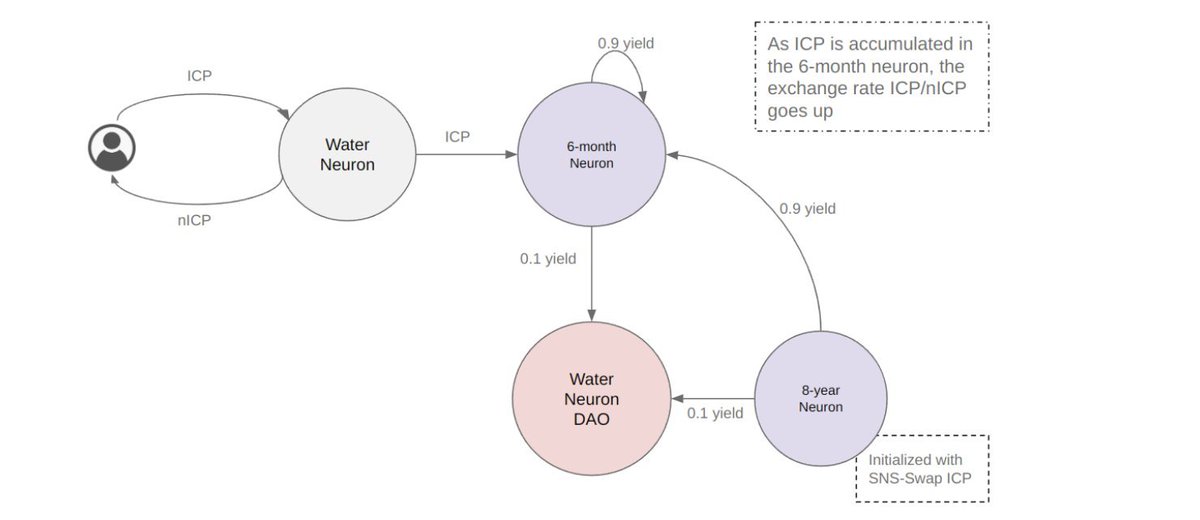
revolutionizes the staking landscape with its liquid staking protocol. Here's a breakdown of its core components:
- Capital and Yield Liquidity: In traditional staking, only the yield (expressed as maturity) is liquid, while the capital remains locked. WaterNeuron's $nICP allows both the capital and yield to remain liquid, providing users with greater flexibility.
- Earning Extra Yield on DEXes: Users can place $nICP in liquidity pools of various exchanges, earning a fraction of the fees on swaps, thus generating additional income.
- Using
- $nICP
- as Collateral:
- $nICP
- can be locked in borrow/lending platforms, allowing users to borrow stablecoins against their "locked neurons," effectively borrowing against their staked assets.
Addressing Key Issues with WaterNeuron
WaterNeuron offers solutions to some of the most pressing issues in the IC and DeFi ecosystem:
- Capital Efficiency: By allowing users to stake ICP and use $nICP in DeFi applications, WaterNeuron ensures that capital remains productive and accessible. This dual exposure to staking rewards and DeFi yields maximizes returns on investment.
- Governance Decentralization: WaterNeuron provides an alternative voting mechanism that reduces the centralization of power within the IC network. By ensuring educated votes and a 100% voting rate, it serves as a counterbalance to DFINITY's influence, fostering a more decentralized ecosystem.
- Hedging Against ICP Inflation: With WaterNeuron, users can stake their ICP and receive $nICP, maintaining liquidity while earning rewards. This approach helps hedge against the 5% annual inflation rate, preserving the value of their assets.
How WaterNeuron Works
The protocol allows users to mint $nICP by swapping their
. The swapped
is then pooled into a 6-month neuron controlled by the WaterNeuron canister. To regain their original
, users can either:
- Swap $nICP for
- $ICP
- on a decentralized exchange (DEX) at a discounted rate.
- Redeem it directly through the protocol, which splits the $ICP into individual 6-month neurons that start dissolving immediately.
The Role of the SNS DAO
WaterNeuron plans to launch an SNS DAO (Service Nervous System Decentralized Autonomous Organization) with a proposal to initiate the initial SNS swap. Here are the key features:
- 8-Year Neurons: All $ICP received from the SNS will be staked in 8-year neurons, with 90% of the voting rewards going to the 6-month neurons ($nICP holders), enhancing their yield.
- Governance Token ($WTN): The remaining 10% of rewards will be disbursed to governance token holders. This incentivizes participation in the governance process, further decentralizing control.
Current SNS Progress
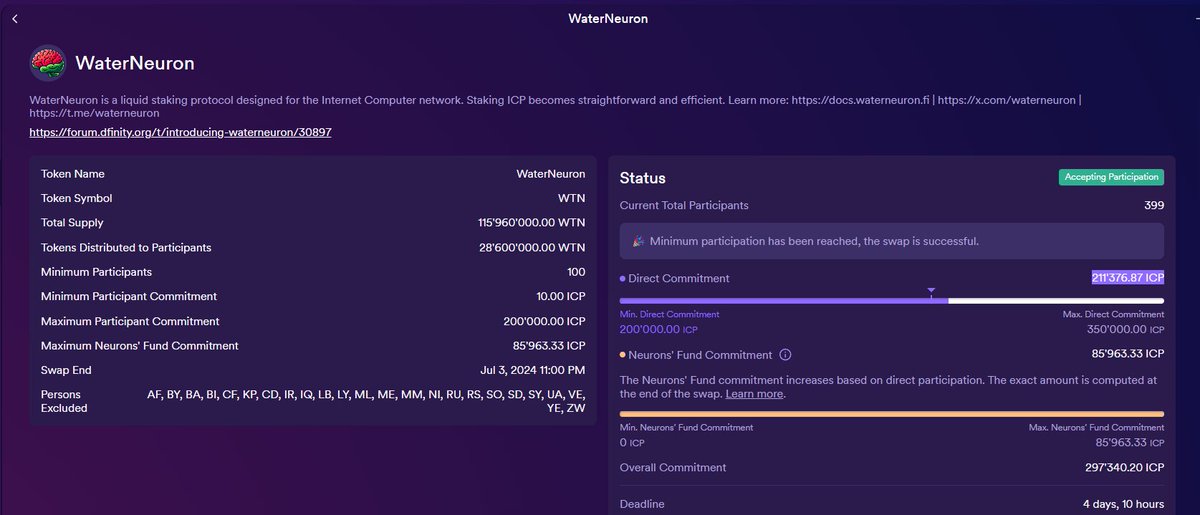
The ongoing SNS (Service Nervous System) campaign has already achieved remarkable success, reaching 211,376.87 ICP with 399 participants and four days remaining until its conclusion. This significant milestone demonstrates the community's strong support and confidence in WaterNeuron's innovative approach to liquid staking and governance decentralization.
Bootstrapping Liquidity
Liquidity is crucial for the success of any DeFi protocol. WaterNeuron employs two primary mechanisms to bootstrap liquidity:
- Enhanced Yield for Early Users: The protocol offers substantial yields for early adopters. For example, if 1 million $ICP is deposited in SNS, the yield from the 8-year neuron will be significant, with APY ranging from 346.95% at 50,000
- $ICP
- TVL to 10% at 6,000,000
- $ICP
- TVL.
- Governance Token Airdrop: A portion of the total $WTN supply will be airdropped to early users, incentivizing participation. Until the protocol reaches 40,000
- $ICP
- TVL, every
- $ICP
- swapped for
- $nICP
- will also receive 64
- $WTN
- . This airdrop continues until the protocol reaches a total of 163,840,000
- $ICP
- swapped.
Why Hold the Governance Token?
The $WTN governance token not only provides voting power but also entitles holders to 10% of the yield from the 6-month neurons. As more users adopt
, the 6-month neuron and the 10% cut for governance token holders will grow, offering substantial returns on investment.
Launch Plans
WaterNeuron is ready to launch as soon as canisters can control neurons. The protocol is already built and has a working version on the testnet. Minimal changes are needed to the existing code to enable canister-controlled neurons, paving the way for a swift rollout.
Engaging the Community
To foster community engagement, WaterNeuron will host a Twitter Live session showcasing the dapp running on the testnet. Discussions and queries are encouraged on Taggr, providing a platform for users to interact and learn more about the protocol.
Conclusion
WaterNeuron is poised to revolutionize the DeFi landscape on the Internet Computer network. By offering a liquid staking solution that enhances capital efficiency, promotes governance decentralization, and hedges against inflation, WaterNeuron addresses some of the most critical challenges in the current DeFi ecosystem. As the protocol gears up for launch, it promises to deliver substantial yields and robust governance mechanisms, paving the way for a more decentralized and efficient future in DeFi. Join us on this exciting journey and unlock the full potential of your ICP with WaterNeuron.


